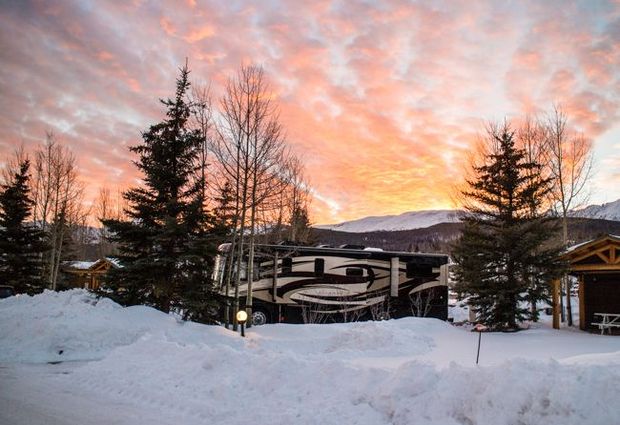
Do you want to use your RV during the Freezing temperatures of Winter?
Got Questions: How do I keep the pipes from freezing in my RV? What can I do to stay warm inside the RV? Can I keep my walls from icing over? Will my fuel freeze? Is it even possible to RV in the Winter? Watch the two videos below on How To Prepare the Outside of Your RV for Winter, and then How to Prepare the Inside of Your RV for Winter…then read the post to get additional tips and tricks, and any updates about How to RV in the Winter.
These videos were shot while winter camping at Tiger Run Resort in Breckenridge, CO.
To be perfectly honest we’ve learned how to RV during the winter from experience….BAD EXPERIENCIES! So please learn from our mistakes and heed our warnings, they truly come from the heart in hopes to make your Winter RV adventures run much more smoothly.
The majority of RV owners do one of two things for Winter:
1. Head South to warmer weather (i.e. Quartzite, Lake Havasu City, Yuma, Gulf Shores Alabama, Florida, etc).
2. Winterize the RV and take it to storage for the season.
We RV a little different! Being slightly crazy we know there are tons of adventures waiting in the snow filled mountains. Honestly the best time to be in a ski town is January – February, there’s less crowds, the snow is better, and the town is filled with mostly locals.

To enjoy the snow and successfully endure the freezing temperatures there are a few things you need to know BEFORE you go on a winter RV adventure.
Cover Windows, Doors and Stairwell – It blows me away how much cold air seeps in from the windows, the entry door and the stairwell, by adding insulation to these drafty culprits you can keep the inside of the RV much warmer. Purchase a heavy fabric and make curtains to keep the cold from coming in. You can do fun curtains or you can install snaps/Velcro around the windows and doors to add an extra layer of insulation. Some people use bubble wrap, the bubble insulation, or the R-Max Foam boards which are all practical but do not look very good. For the stairwell have a board cut and adhere insulation to the bottom of it, at night cover the stairwell to keep out the cold air.
Skirting your RV – If you have an RV without insulated bays, or a trailer, you will need skirting in extreme weather. The majority of RV’s are not made for extreme cold so chances are if you plan to be in consistent freezing temps you should look into investing in this. In some cases if temperatures drop below 0 degrees you will need to run a space heater under your coach (inside your skirting) to keep it warm. I stay away from propane heaters and use an electric commercial heater under our RV.
We had to skirt our first RV and it worked like a champ. We called the Miller Family from RVSkirting.com and even though they couldn’t install the skirt for us they helped us get set for a last minute freeze in Breckenridge, CO and gave us the confidence that we could install it ourselves. Most manufacturers and dealers don’t understand skirting so make sure you do lots of research or give these guys a call if you have questions about winter camping.If you plan to be in an area with snow you can try the poor man’s skirt, it works pretty well: Take a shovel and pile up snow all around your coach up to the bays. Pack the snow well and it can last for months. During an extreme freeze put a space heater under your coach, don’t worry it shouldn’t melt the snow…I call this the Igloo effect!

Cheap Heat Options – We’ve seen 2 options that seem to work well for heating the RV inexpensively in the winter (when you’re staying at an RV park for a month or more you will often have to pay for electricity, so space heaters might end up costing you some extra money each month in electricity bills). Of course you have to calculate the expense of the product and the install costs:

- Propane Heater – This device sips propane compared to the furnace installed on your RV, yet it keeps the inside even warmer. Best part is this heater doesn’t use electricity like a space heater but it heats just as well. The downsides: There is no anti-tip shutoff so it’s not good if you have pets. The install can be simple but should be completed by a professional. The propane is un-vented and therefore produces deadly Carbon Monoxide so you must keep a vent open at all times and constantly check your CO detector to make sure it is functioning properly. Also as discussed propane heat produces humidity. Our friends the RV Geeks use this propane furnace and swear by it in their Winter RVing post
- Pellet Stove – This device will warm up an RV faster and more efficiently than any other heater we’ve seen. The good news is there is zero moisture produced from the heat, the built in fan uses a fraction of the electricity of a space heater and it’s a pretty eco friendly option for heating. The downsides: Install is a crazy mod to both the inside and outside of your RV. If the fan shuts down (i.e. when boondocking and you run out of battery power) you now have a smoke filled RV. Takes up a lot of space so is best for larger RV’s. You have to carry and store large, heavy wood pellets in your RV. Some models you are required to vacuum out the ashes which can be a pain make sure you look at the pellet stoves with a removable ash tray.

Heated Water Hose – You can make your own with heat tape and pipe insulation and this works pretty well, although on occasion we have seen people in the bathrooms warming up their frozen hoses during extreme cold snaps. I’d recommend just purchasing a good heated water hose. Camco has one on the market but it looks kinda cheap, from the heated hoses I’ve seen in person I’d recommend the Pirit Heated Hose
as the construction and the warranty seem top notch.
Available on Amazon: http://amzn.to/295bNsL
No matter which way you decide to go, make sure you cover and insulate any exposed piping coming from the water supply and the spigot! If your water connection to the RV is on the exterior of the wall (not inside a bay/basement) you will also need to cover and insulate that connection very well. If you do have a wet bay you should consider placing a space heater in the bay just in case temps get low enough to freeze and burst the connection.

Sewer Hose – Use a PVC pipe for your sewer line instead of the standard RV drain hose, it will hold up much better in the freezing temps. If you have a constant water supply and you want to let your grey water drain the safest thing you can do is wrap the sewer pipe with additional insulation, if temps will be freezing for multiple days you may want to install heat tape around the PVC pipe. I always recommend keeping the black tank closed off and dumping only when necessary, getting a #poopcicle stuck in the drain is not a good way to start the day.
Keeping the Inside and the Bays Warm
1. Space heaters are your friend! If you’re plugged into shore power why waste your money running the propane furnace inside your RV? For sub-freezing temperatures we typically run 2 space heaters inside: 1 near the front, and one near the bedroom.


**UPDATE** – We spent the “big bucks” and splurged on the Dyson Air Blade Heater and we can honestly say it’s worth EVERY PENNY! We’ve used it in 20 degree temps and we can put it in the windshield, turn it on and it keeps the RV warm all the way in the bedroom! Amazingly efficient and safe heat for the RV.
Available on Amazon: http://amzn.to/29bHDF9


Typically there is one main bay that holds your black/grey/fresh tanks, your sewer connections, water pump, water filter, etc. This is the MOST important bay to keep warm. I purchased a tiny 200 watt (1.8 x 4.3 x 6.1 inches) ceramic heater and leave it running in the bay during freezing temperatures. It pulls about 5 amps and keeps all my pipes warm (exterior temp 20 degrees, inside bay 50 degrees). Some people recommend hanging a work light in the bay: I tried this and the bulb melted the plastic bay, and my water still froze so I don’t recommend this option.
Available on Amazon: http://amzn.to/298Q8QA

Your water hose WILL FREEZE! Do not leave your water hose connected during freezing temperatures. There are special water hoses you can plug in to keep warm, you can also make a heated water hose using Pipe Heating Cable (Heat Tape)

and Insulating Foam Pipe Covers

. During extreme freeze your ‘heated’ water hose may still freeze. Numerous times I’ve seen people in the bathroom trying to thaw their heated hoses. Save money and save hassle, just fill your fresh water tank and disconnect your hose, repeat when necessary (it’s really not a big deal and it will save you money and you won’t have to store a bulky winter water hose all year)
Available on Amazon: http://amzn.to/293vsqa
4. Insulate your pipes

It might not do much, but why not. Go to the hardware store and purchase the pipe insulation. Wrap any and every pipe you can find with the insulation. It’s easy to do, inexpensive, and maybe it’ll help keep the pipes a little warmer in the winter and cooler in the summer?
Available on Amazon: http://amzn.to/298QtD1


Invest in a heated mattress pad, it will be your friend during cold nights. We purchased a dual climate heated pad (not a heated blanket) because one of us is always colder than the other, it works like a champ. Best part is the preheat function warms the bed quickly then continues with your original setting. We chose a heated mattress pad because heat rises right? The heat is nice on our backs, then as the warmth rises its captured between the sheets and creates a nice oven effect. Love it! Although we’ve heard a heated blanket can mess up your core temps we still use one on the lowest setting when it’s sub-freezing outside. Unfortunately the new mattress in our Fleetwood Excursion is memory foam so it doesn’t work with a heated mattress pad….we’re so missing our pre-heat button this year!
Available on Amazon: http://amzn.to/29ga57l
Miscellaneous Winter Necessities:

RV Tire Chains:
Legally you must carry chains to drive many mountain passes during snow storms (especially in California). If you don’t have chains on board and you get busted it’s a hefty fine. We’ve spent winters all over the states, and fortunately we’ve never had to put our chains on. Of course we watch the weather religiously before we plan to drive anywhere. If you’re flexible like we are and you know a storm is coming you have 2 options: 1. Bust out of there ASAP before the snow or 2. welcome the snow with open arms and extend your campground reservation a couple more days.

Keep your engine from freezing

Diesel can freeze! Make sure you fill with winterized diesel which you can find at most truck stops. If you can’t find winterized diesel you need to purchase an additive that will keep your diesel from freezing (you can find this at auto part stores and truck stops). Before you depart your destination you should plug in the heating element found in your diesel engine (most diesel engines have a heated core that you can plug into a wall to keep them from getting too cold) to warm up your engine at least 4 hours before taking off.
Available on Amazon: http://amzn.to/295dpCD
Protecting the RV Engine and Generator from Freezing – From the Experts
All 3 of our RV’s have been diesel, similar rules might apply for gas RV’s so ask the Mfr for advice. Diesel fuel begins to gel around 20 degrees and can damage your engine. I have received these tips directly from Fleetwood, Cummins, and Freightliner so this information is solid!
- Fuel – Before entering freezing temps make sure to add a Diesel Anti-Gel Supplement. Both Cummins and Freightliner recommend the Power Service brand of anti-gel
- Engine Block Heater – A lot of mis-guiding information about the engine block heater, here’s what the experts say:
- Temps between 32-10 degrees Fahrenheit: Turn on block heater 4 hours before starting the engine.
- Temps below 10 degrees Fahrenheit: Turn on and leave on engine block heater until temps rise above 10.
- Always turn off block heater while engine is running.
- Oil – Recommended Generator Oil for freezing temps is 15W-40
- Departure – Before you depart the campground in cold weather turn on the engine block heater for a minimum of 4 hours and run the generator for 30 minutes with a low-medium load. This routes the fuel to the generator but not all the fuel is burned. The fuel that is not burned follows a return line back to the fuel tank, effectively warming up the fuel and giving the engine warm fuel for a better start. Make sure your engine and transmission have time to warm up before jumping directly onto the highway.


In the winter you’ll notice condensation accumulating on the windshield, on walls, etc. Condensation is your enemy. I know it sounds contradictory but you need to crack a vent or a window at all times. Condensation can build up, get in the walls, etc and cause mold. You do not want this! Simply crack a window and turn on a fan to circulate the air, if you’re already using a space heater with built in fan you don’t have to worry about running a separate fan. You can also put the dehumidifier pellets like Damp Rid or DriZair (you can purchase at most stores) in the areas that seem to draw the most condensation. We’ve found the condensation will not pose a problem as long as it’s 40% relative humidity or less inside the RV.
Vent Covers
We’ve always installed MaxxAir vent covers on all 3 of our RV’s. During the winter a vent cover is a must as it adds an extra barrier against condensation, and when there’s a pile of snow on the roof you can still open the vents while cooking (or if you need to let some condensation escape). We installed a new MaxxFan on the Fleetwood and it combines the vent cover into the fan, it seemed to hold up pretty well to the elements however we didn’t have a more than a few inches of snow at a time. In our first RV (the Damon Avanti) we purchased the vent ‘pillows’ to help keep warm air in, and keep down condensation and they worked well, but we got tired of carrying them around all year for a few days here and there of snowy weather.


The solids must be above 55 degrees Fahrenheit in order to compost. If you have a composting toilet like us make sure the surrounding ambient temperature is at or above 55.
More on Composting toilets here: https://www.gonewiththewynns.com/all-composting-toilet
and more stuff you need
De-Icer, Snow Shovel, Ice Scraper, Jack Pads (to keep the jacks from freezing to the ground), Winter Wiper Fluid, and some warm boots and winter clothes of course!
Winter RV Campgrounds
Don’t assume a campground will be open, make sure you contact the resort before you plan a visit. Many campgrounds close during the winter, especially in areas where it snows. Surprisingly a ton of State Parks close as soon as snow hits the ground, so do your research!
Boondocking
As much as we love Wild Camping our general rule of thumb is: if its freezing outside you don’t want to be boondocking. Sure you can run your generator and use propane to heat the interior, but you’re gonna spend $20+ per day anyway so you might as well find a nice RV park and plug in.
For the Lazy or the Budget RV’er
Last but certainly not least there is always the option to winterize your RV before you hit the cold weather. Whether you’re lazy, cheap, or you just plain don’t want to deal with all this crap I’ve rambled on about above, this option works like a champ. Before you hit the road purchase a couple 10 gallon jugs of water for drinking. Shower & use the toilets in the facilities at the campground (they’re usually heated during the winter). Of course this means when nature calls you have to high tail it through the freezing weather to use the Jon, but at least you don’t have to worry about your pipes freezing! If you decide to go this route make sure you stay in the site located closest to shower and bathroom facilities, you’ll thank me later.
Do you RV in the Winter? Have some of your own tips? Share them with the world below in the comment box.
Please know these tips are just that: Tips. I cannot guarantee that your RV won’t freeze, or that your vacation will go perfectly. If you’re new to winter RVing make sure you read the comments, there are so many great tips from our friends! That said enjoy the cold, we sure do!
Below are continual updates as we run into new winter camping adventures. Keep checking back as we are always learn something new that must be shared:
01/2014 We Froze: Fleetwood Excursion
With all the tips and tricks we’ve shared there are so many variables that are unknown when winter camping for the first time in a new RV. Here are some of the vulnerabilities we found with the Fleetwood Excursion for Winter RVing:
Issue: Fresh Water Freezes – We realized the fresh water tank is not well protected so in sustained temperatures below 30 degrees the fresh water tank will freeze.
Solution: We purchased a $20 space heater with a variable thermostat so when the temps fall below freezing the space heater kicks on and off keeping the bay warm while using as little electricity as possible. Once we put the heater in the bay we didn’t freeze again.
Issue: Water Lines Freeze – When temps fall in the single digits our lines from the hot water tank freeze. (The cold water will still work in the kitchen because the freshwater tank is not frozen and the lines come from the bays that are heated with space heaters.) The lines sit on the floor very close to the wall behind cabinet drawers, a typical location for many RVs.
Solution: This issue happened twice in very cold weather. We decided not to bother with a fix since the temps were rising in the coming days. The issue could be fixed with multiple options but I would do one of these: 1) skirting adds an extra layer of insulation and will keep the basement compartment warmer, thus keeping the floors warmer. 2) Install pipe insulation around all lines that sit on the floor and/or touch the outside walls. If you’re planning to be in sub-zero temps for multiple days you might want to do both.
02/2013 The Perfect Solution for Not Freezing
After a month of staying in overnight freezing temperatures I’ve finally figured out the perfect solution to keeping your RV from freezing, it’s really the only guaranteed way to keep those RV pipes running: Drive to warmer temperatures. 🙂 Oh yea, there is one other way that’s a guarantee: winterize your RV!
If you’re like me and not willing to do either of these then here’s what the past month has taught me (based on the Monaco Vesta):
1. Arizona Does freeze, it may be rare in the valley but it does happen (and it happens often in the higher elevations).
2. An overnight freeze will not burst your pipes, however multiple freezes without thawing can.
3. The RV tank heating pad does not work for a full tank of water.
4. Skirting your RV is the absolute best way to protect your RV from freezing.If you can’t skirt your RV here’s the formula that has worked for me in temperatures down to 0 degrees Fahrenheit at night, and temperatures in the 30’s during the day.
1. Fill freshwater tank to 1/3
2. Disconnect water hose
3. Empty Black and Grey water to 1/3 or less (but not empty)
4. Remove sewer hose and close any openings in bays
5. Turn on RV tank heating pads (assuming you have pads on each tank)
6. Turn on mini wet bay heater
7. Set propane furnace to 55 or higher (depending on your preference)
8. Turn on the strongest, warmest space heater you can find
9. Cuddle up under a nice, thick, warm blanket and enjoy the snow. This simple formula worked for us for several nights in a row of sub-freezing nightly temperatures. Each day it warmed up in the high 20’s or low 30’s, which is still freezing but we were able to keep all our pipes from freezing using these simple steps.
If none of my tips make any sense than I suggest you read the main part of the post below, we’ve stayed in freezing temps for years now, and we absolutely love the solidarity of cold weather camping. Also if you want to learn a little more our friend Tom Conces left a very detailed comment in the comments section that you absolutely must read.
01/14/2013 Our RV Pipes FROZE – Monaco Vesta
It’s official, we froze! Well, to be more clear our freshwater tank froze. After surviving months in the Colorado Rockies without freezing, imagine our surprise when we froze solid in AZ! Well, I honestly can’t believe it. After careful consideration, and a talk with the service technicians at Monaco here’s what I’ve learned about our Vesta, and this applies to most any RV that’s not completely sealed.
Let me setup the situation:
01/11/2013 – High 22 Low -9 We did not freeze
01/12/2013 – High 22 Low -5 Tank froze till noon
01/13/2013 – High 29 Low 0 Tank froze till 2pm
01/14/2013 – High 30 Low 6 Tank froze till noon
I followed all my own directions as notated in this original post below EXCEPT for skirting. I don’t have a skirt for our Windy, and there was no snow on the ground so I couldn’t make an impromptu skirt. So today we’re a little more wise and humbly we offer a few new points on preparing your RV for Winter:1. Skirting – Anytime the temperatures will be sub 30 for more than a half day adding a skirt is the BEST way to keep your RV from freezing. If we would have skirted our Motorhome this wouldn’t have been an issue. That’s what I get for being lazy!
2. The 12 volt tank blankets will not keep a full freshwater tank from freezing. Granted they will help thaw the tanks, but when the temp drops near zero don’t expect those little heating pads to do much of anything.
3. Frozen tanks don’t unfreeze easily. If you’re not skirted then any warmth that is generated under your RV will simply blow away. Also when the sun comes out the bottom of your RV (where your tanks are likely located) is still in shade. So unless the temps go over 35 degrees for an extended period of time you’re tanks won’t unfreeze.
4. Turn off your Water Pump. If your tank freezes your water pump will burn up trying to run, so don’t risk it. When you go to bed turn off your pump.
5. Keep on your electric water heater. Don’t blow up your water heater with freezing water. Keep the electric heater on in order to keep your tank from bursting with freezing water.
6. 30 Amp Sucks! The campground we’re at only has 30A hookups. When I’m using my 2 space heaters, the electric water heater, refrigerator and the engine block heater we’re pulling 29 amps. That means we must remember to turn off the heaters when using any other appliances. If you’re RV only has 30A, I’m sorry cause that is a major pain!
7. RV’s aren’t air tight. I don’t care if you’re in a $2,000,000 bus or a $5,000 trailer your RV is not sealed like a bricks and sticks home. Cold air leaks in under the slides, permeates through the walls, and seeps through the windows. If you plan to stay in freezing weather for an extended period of time locate those drafty areas and throw a blanket over them. For our Windy it’s amazing how much cold air comes in through the entry door area, so I cover the stairwell with a piece of board and my rug at night.
8. Use the propane furnace. I don’t care how many space heaters you have going, if it’s 0 degrees outside those little heaters won’t keep the entire coach warm. We set our furnace to 55 degrees and we’ll hear it kick on throughout the night. Our philosophy: a $30 propane bill is much better than a $300 busted pipe bill!
9. Suck it up and do the walk of shame. When the pipes are frozen, don’t expect them to thaw anytime soon. Pack up your dop kit, and throw on your coat, cause you’re walkin’ to the shower facility to drop that morning constitution.
2011 – 2013 Keeping our Monaco Vesta from Freezing in Winter
I have a detailed post on How to Prepare the Monaco Vesta for Winter if you’d like to read it over. Basically it’s the same as the Damon Avanti which I’ve addressed in the previous toggle except the RV Electric/Propane fridge in the Vesta has an Ice Maker. So in extreme temps I had to drain the ice line filter and turn off the water. In addition I used a small space heater in the vent area for extremely cold nights so the pipes wouldn’t burst.
2010 – 2011 Keeping our Damon Avanti RV from Freezing in Winter
This RV was our first to take on a Winter adventure. This is where we learned most of our tips and tricks as we made the most mistakes with this RV. Really the number one thing we did was install skirting made from heavy duty vinyl fabric. We brought the skirting above the bay doors to help insulate the items in the bays. The biggest difference between the Damon Avanti and our Fleetwood Excursion is the basement. The Avanti is a Front Engine Diesel so there is no basement, so the tanks are exposed without skirting. The major benefit to this type of RV is once we skirt we simply put a space heater underneath the skirting and it kept most everything from freezing. All the basic other rules we’ve outlined apply with this RV as well.EXCEPT – we used a 60 watt light bulb inside a standard ‘hanging trouble light’ fixture to keep the wet bay warm. Over the process of 10 days the bulb eventually started to melt the plastic bay. This is why I do not use a light bulb anymore.The other difference is the RV Electric/Propane fridge – To keep cold air from seeping in we used duct tape to cover the vents located on the outside of the RV.
2014 All Electric Tips from a Fellow Winter RV Traveler
Tom Conces is a friend we’ve bumped into on the road several times over the past few years. He reached out to me a little over a year ago and asked “what do I need to do to survive in my RV during freezing temperatures?” Ya see Tom is a much crazier photographer than I am, he wanted to park his RV in subzero temps in order to photograph bald eagles as they swoop down in the snow banked rivers to catch fish. I told him you’re crazy, then I said read our post on How to Prepare an RV for a Freezing Winter Adventure. Needless to say Tom learned a few things while freezing his tail off in the Midwest during Winter, so I thought he should share his experiences (from the horse’s mouth as the saying goes).
1. Smokey:
2. Cold Diesel:
3. Keep the fresh water and pipes from freezing:
4. Skirting as you pointed out is an absolute must:
5. Insulation:
You can see some of Tom’s photographs and read Lorraine’s blog at navigatingtheunknown.blogspot.com
We were not compensated by anyone to create this post. This is all based on our experience over the past few years, read our disclaimer for more info.